
Root Canal Alternatives That May Save Your Tooth
Considering root canal alternatives? See which treatments may save your tooth, when extraction is needed, and why an independent review can clarify choices.
A root canal recommendation can feel urgent, expensive, and difficult to question. You may be dealing with pain, an unexpected treatment plan, or a dentist telling you that the tooth will not survive without immediate treatment. Root canal alternatives do exist in some cases, but the right option depends on what is actually happening inside and around the tooth – not simply what is least invasive or least expensive today.
The goal is usually to keep a natural tooth when it can be predictably saved. But that requires a clear diagnosis. Before agreeing to treatment, it is reasonable to ask what the X-rays show, whether the tooth pulp is still alive, whether the infection has reached the root, and what could happen if you wait or choose another approach.
When a Root Canal Is Usually Recommended
A root canal treats the soft tissue inside a tooth, called the pulp. The pulp contains nerves and blood vessels. When it is severely inflamed, infected, or dead, bacteria can move through the root canal system and into the surrounding bone. A dentist removes the damaged tissue, disinfects the inside of the tooth, seals it, and usually recommends a crown afterward to protect the tooth from fracture.
A root canal may be appropriate when there is lingering sensitivity to heat or cold, spontaneous pain, a deep cavity close to the nerve, trauma, swelling, a draining bump on the gums, or signs of infection near the root tip on an X-ray. Still, symptoms and X-rays must be interpreted together. A dark area on an X-ray does not automatically tell the whole story, and a tooth can be painful for reasons unrelated to an infected pulp.
This is why the diagnosis matters as much as the treatment recommendation. A root canal is often an effective way to preserve a tooth, but it should not be treated as an automatic answer to every deep cavity or episode of tooth pain.
Root Canal Alternatives: What May Be Possible
The alternatives fall into two very different categories. Some are conservative treatments intended to keep the tooth vital, meaning the pulp remains alive. Others involve removing the tooth when saving it is not predictable. Neither category is universally better. The best choice depends on the tooth’s condition, your overall oral health, and the quality of the supporting evidence.
Monitoring and a protective restoration
If decay is deep but the pulp is not irreversibly damaged, a dentist may remove the decay, place a protective liner or filling, and monitor the tooth. This can be appropriate when symptoms are mild, brief, or absent and testing suggests the nerve may recover.
This approach has a trade-off. It can avoid more invasive treatment now, but the tooth may later develop symptoms and require a root canal. Monitoring should not mean ignoring a tooth with worsening pain, swelling, or clear signs of infection. It should include a specific follow-up plan and an explanation of what changes should prompt you to call.
Indirect pulp treatment or pulp capping
When decay is very close to the pulp, removing every trace of softened dentin can expose the nerve. In selected cases, a dentist may leave a small amount of affected tissue, place a medicated protective material over it, and seal the tooth with a well-fitted restoration. This is often called indirect pulp treatment.
A direct pulp cap may be considered when the pulp is exposed in a limited, controlled situation, such as during cavity removal or after a recent injury. Modern materials have improved the success of these procedures, but results depend on careful isolation, bacteria control, the size and cause of the exposure, and the health of the pulp. A pulp cap is not a dependable substitute when the nerve is already severely infected or dying.
Vital pulp therapy
Vital pulp therapy is a broader term for treatments designed to preserve healthy or recoverable pulp tissue. Depending on the case, it may involve removing only a small portion of inflamed pulp rather than performing a full root canal.
This can be a valuable option, especially for younger teeth or carefully selected adult teeth. However, it requires a clinician to make a precise judgment during treatment. If infection has extended deeper into the pulp, partial treatment may fail and a root canal or extraction may still be needed later. Ask how the clinician determined that the remaining pulp is healthy enough to keep.
Replacing a failing restoration
Sometimes the concern is not the nerve itself but a leaking filling, a cracked restoration, bite pressure, or exposed dentin causing sensitivity. Replacing an old filling or crown, adjusting the bite, or protecting exposed root surfaces may resolve symptoms when the pulp tests normally.
This is also where clear records matter. A treatment plan should identify whether the issue is decay, a fracture, gum disease, a failing restoration, nerve damage, or a combination. These conditions can look similar to a patient because they all may cause pain when chewing or sensitivity to temperature.
Extraction and tooth replacement
If the tooth is severely cracked, has inadequate remaining structure, has advanced infection that cannot be predictably treated, or has poor bone and gum support, extraction may be the more practical choice. It is not always a failure. In some circumstances, removing a tooth avoids repeated procedures with a low chance of long-term success.
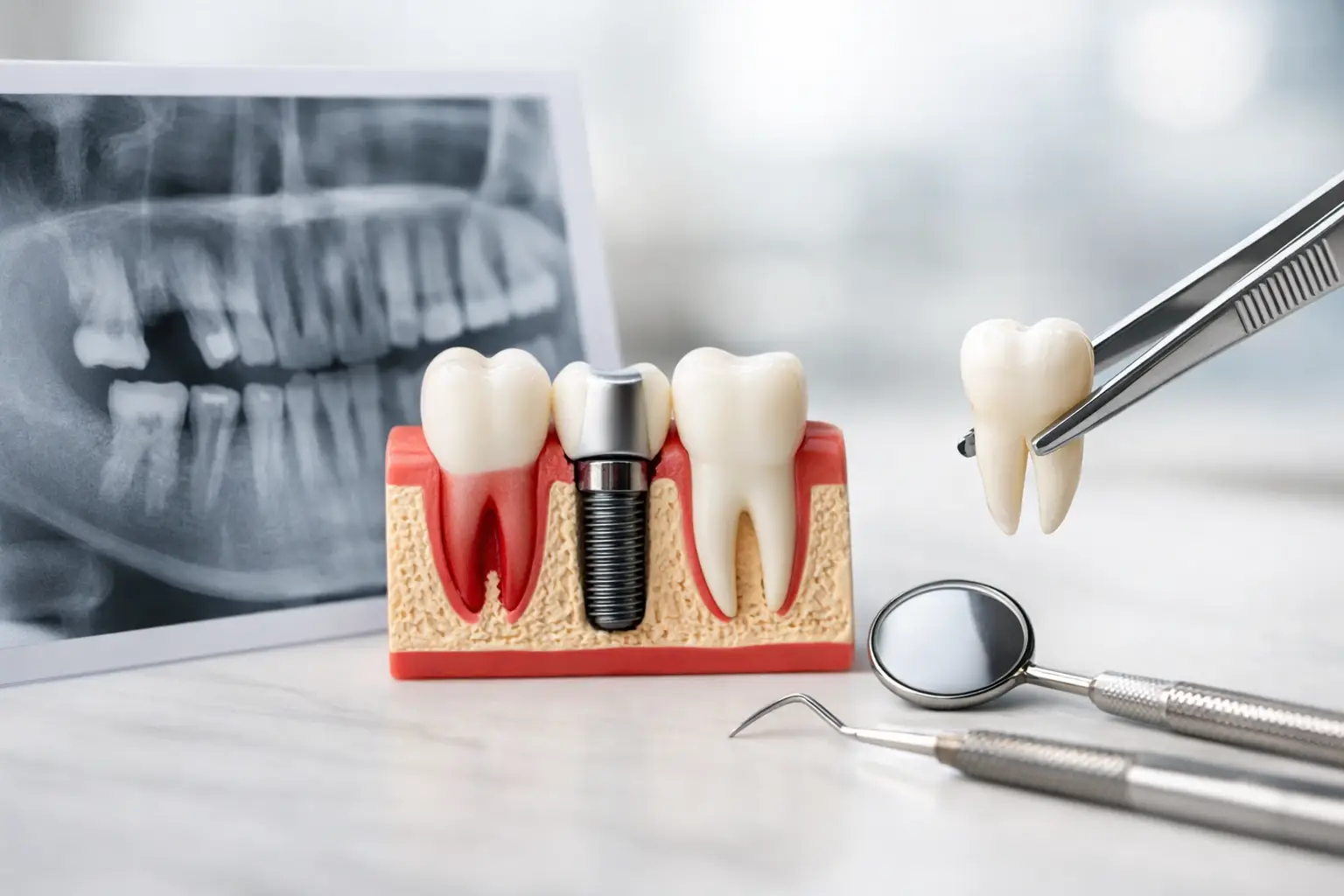
But extraction creates its own decision. The space may need to be replaced with an implant, bridge, or removable appliance to support chewing and limit tooth movement. Each option has cost, healing time, maintenance, and suitability considerations. Leaving the space open can be reasonable in limited situations, but it should be a deliberate decision rather than an afterthought.
What Is Not a Reliable Alternative
Antibiotics may be necessary when there is spreading infection, fever, facial swelling, or certain medical risks. They can help control bacterial spread, but they do not remove infected tissue inside a tooth. Pain medicine may reduce discomfort, but it does not treat the cause either.
Be cautious about anyone presenting supplements, oil pulling, or home remedies as a way to cure an infected tooth. They may offer temporary comfort for some symptoms, but they cannot disinfect and seal an infected root canal system. Delaying needed care can allow infection, pain, and bone loss to worsen.
Questions to Ask Before You Decide
You deserve answers that are specific to your tooth, not a general reassurance that treatment is necessary. Ask to see the relevant X-ray and ask what it shows. Find out whether pulp testing was performed, whether there is a crack, how much healthy tooth structure remains, and whether the tooth needs a crown after treatment.
Also ask about prognosis. A useful question is: “What is the expected success rate for a root canal in this tooth compared with the conservative option or extraction?” Another is: “What finding would make the alternative unsuitable?” These questions shift the conversation from a one-size-fits-all recommendation to evidence, risks, and expected outcomes.
If cost is part of the decision, request an itemized estimate. A root canal may involve separate fees for the endodontist, final restoration, buildup, crown, and any follow-up imaging. Extraction and replacement can also become a multi-step plan. Comparing only the first appointment cost can be misleading.
When an Independent Review Can Help
A second opinion is especially useful when the diagnosis was based on limited explanation, the proposed work is costly, different dentists have given different answers, or you have little or no pain but were told treatment cannot wait. Relevant records may include the treatment plan, cost estimate, X-rays, clinical photographs, and notes about symptoms or pulp testing.
An independent review cannot replace an in-person examination or treat an emergency. It can, however, help you understand whether the records support the recommendation, what questions remain unanswered, and whether root canal alternatives appear reasonable to discuss with your treating dentist. Second Opinion in Dentistry provides written reviews from licensed dental professionals without selling the procedures being evaluated – no upselling, no pressure.
Seek prompt in-person care if you have facial swelling, fever, trouble swallowing or breathing, swelling near the eye, rapidly increasing pain, or feel generally unwell. Those symptoms can signal an infection that needs urgent evaluation.
A tooth may be worth saving, but you should not have to make a major dental decision based on fear, vague explanations, or a rushed estimate. Clear records, a defined diagnosis, and honest discussion of the alternatives give you a better foundation for choosing what happens next.