What an Unbiased Dental Diagnosis Review Checks
An unbiased dental diagnosis review explains whether recommended treatment is necessary, what alternatives exist, and what your records may really show.
A treatment plan for crowns, implants, root canals, or gum treatment can arrive with a price tag in the thousands and a request to schedule quickly. An unbiased dental diagnosis review gives you room to pause. It asks a simple but essential question: does the clinical evidence support the treatment being recommended?
That question is not an accusation against your dentist. Many recommendations are appropriate and time-sensitive. But when treatment is costly, irreversible, or unexpectedly extensive, you deserve a clear explanation from a licensed dental professional who has no financial benefit from the procedures being reviewed.
What an unbiased dental diagnosis review is
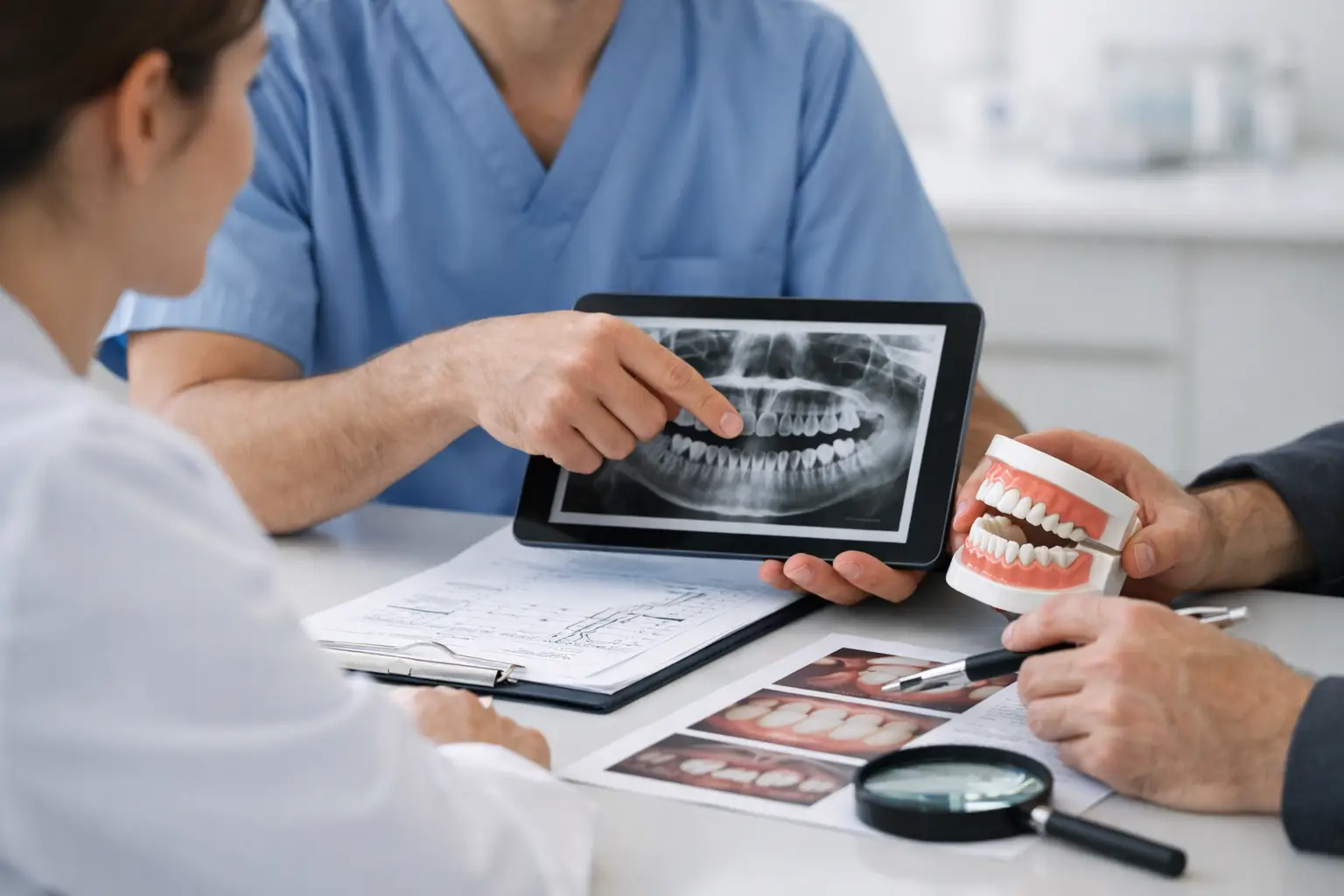
An independent review is a written evaluation of the records behind a dental recommendation. Depending on the materials available, a reviewing dentist may assess X-rays, intraoral photos, clinical notes, periodontal charting, treatment plans, and cost estimates. The goal is to clarify what the records appear to show, whether the proposed scope of care is supported, and where questions remain.
The distinction is independence. A dentist who performs a procedure may be acting in good faith, but their practice is also paid when treatment goes forward. An independent reviewer does not perform your procedure, sell dental work, or earn more if you accept a larger treatment plan. That separation helps keep the conversation centered on evidence, alternatives, and your priorities.
A review does not replace an in-person examination, establish a new patient relationship with a local treating dentist, or provide emergency care. It can, however, help you decide whether to proceed, seek a local examination, ask for more documentation, or discuss a less extensive approach.
What records can reveal about a recommendation
Dental records are not all equally useful. A treatment plan alone tells a reviewer what was proposed, but not necessarily why. X-rays and supporting documentation provide the context needed to assess the reasoning behind it.
X-rays and images
X-rays can show signs of decay between teeth, infection near a root, bone loss, impacted teeth, existing restorations, and changes around implants. They also have limits. Image quality, angulation, and the type of X-ray can affect what is visible. A small cavity, crack, or painful tooth may not be fully explained by an X-ray alone.
Clear photographs can add useful context, especially for visible fractures, worn teeth, broken fillings, gum recession, and cosmetic concerns. They cannot substitute for a hands-on exam, but they can help a reviewer understand the condition of teeth that may not be clearly represented on a radiograph.
The diagnosis and treatment sequence
A careful review considers whether the diagnosis matches the recommended procedure. For example, a tooth proposed for a crown may need a crown because it has extensive decay, a large failing filling, a fracture risk, or previous root canal treatment. The records should help explain which of those factors applies.
It also considers sequence. If several procedures are recommended, are urgent problems being addressed first? Is periodontal disease being managed before major restorative work? Is there enough information to determine whether a tooth is restorable before moving directly to extraction and implant planning? The right order depends on your clinical situation, but it should be understandable.
Alternatives and monitoring
Not every problem has only one reasonable answer. Some findings require prompt treatment, while others may support monitoring, a smaller restoration, a temporary approach, or additional testing first. The appropriate option depends on symptoms, risk level, the amount of tooth structure remaining, your long-term goals, and the quality of available records.
An honest review should not promise that the least expensive option is always best. It should explain the trade-offs. Saving a tooth may be worthwhile, but it can involve repeated treatment and uncertain longevity. Replacing a tooth with an implant may offer benefits, but it is surgery and may require bone grafting, healing time, and ongoing maintenance. Clear advice means seeing both the benefit and the cost of each path.
When a second review is especially useful
A second review can be valuable whenever you do not feel fully informed. It is particularly helpful when recommendations from two offices differ, when a plan includes multiple crowns or implants, or when you were told a tooth needs immediate extraction without a clear explanation.
It can also help when the estimate is difficult to interpret. Dental estimates often combine diagnostic work, surgery, restorations, lab fees, anesthesia, and follow-up visits. A reviewer can help identify what each recommended phase is intended to accomplish and which questions to bring back to your treating office. They cannot set your local dentist’s fees, but understanding the scope makes it easier to compare like with like.
Urgency is one area where context matters. Severe swelling, fever, trouble swallowing, uncontrolled bleeding, facial trauma, or difficulty breathing require urgent in-person medical or dental care. Do not wait for an online review in those situations. For non-emergency decisions, a review can provide useful clarity before you commit.
What to upload for a meaningful review
The best review starts with complete, readable records. If your dental office gave you a treatment plan and estimate, upload both. Ask for copies of the X-rays used to make the recommendation, not just a screenshot of the plan. Digital X-rays, periodontal charting, clinical notes, and photos can be helpful when available.
Include a short description in your own words. Explain which tooth or area concerns you, whether you have pain or sensitivity, how long symptoms have been present, and what your dentist told you. If you have received more than one recommendation, provide both plans. Differences between them may be clinically meaningful, or they may reflect different assumptions that need to be explained.
Before sending records, make sure names, dates, tooth numbers, and images are legible. Blurry photos and cropped X-rays can limit what any reviewer can responsibly say. Secure upload matters as well. Your dental records are personal health information and should be handled through a confidential process.
Questions a written review should answer
A useful written opinion should leave you with more than a yes or no. It should explain what evidence supports the diagnosis, what cannot be confirmed from the records, and whether additional information would change the assessment.
Look for plain answers to practical questions: Is the recommended treatment supported by the available documentation? Which procedures appear urgent, and which may be elective or suitable for monitoring? Are there conservative alternatives worth discussing? Does the proposed sequence make sense? What should you ask your local dentist before deciding?
Second Opinion in Dentistry provides this type of independent written review online, with licensed dental professionals evaluating submitted records rather than selling treatment. The purpose is not to tell you what you must choose. It is to give you clear, financially neutral information so the choice is genuinely yours.
How to use the review at your next appointment
Bring the written opinion to your treating dentist and keep the conversation specific. You might ask them to show you the X-ray finding behind a recommended crown, explain why a tooth is not considered restorable, or describe why a proposed alternative is not suitable in your case.
A good treating dentist should be able to explain their reasoning, including where professional judgment is involved. A difference of opinion does not automatically mean someone is wrong. Dentistry often involves judgment about risk, longevity, and timing. What matters is that you understand the evidence, the uncertainty, and the consequences of waiting or choosing another option.
You should never feel rushed into irreversible dental work simply because the recommendation was presented with confidence. Get the records, get clear answers, and make the next decision with the facts in front of you.