
How to Compare Implant Options Without Pressure
Learn how to compare implant options by reviewing diagnosis, costs, materials, timelines, and alternatives before you commit to treatment with confidence.
A dental implant recommendation can arrive with a large estimate, unfamiliar terms, and a sense that you need to decide quickly. Knowing how to compare implant options gives you room to ask the right questions before committing to surgery and restoration. The best choice is not always the most extensive treatment plan, the lowest quote, or the fastest timeline. It is the option that fits your oral health, long-term goals, budget, and the evidence in your records.
Dental implants can be an excellent solution for replacing missing teeth. They can also be part of a plan that is more complex than necessary. A clear comparison starts with the diagnosis, not the sales presentation.
Start With the Reason an Implant Was Recommended
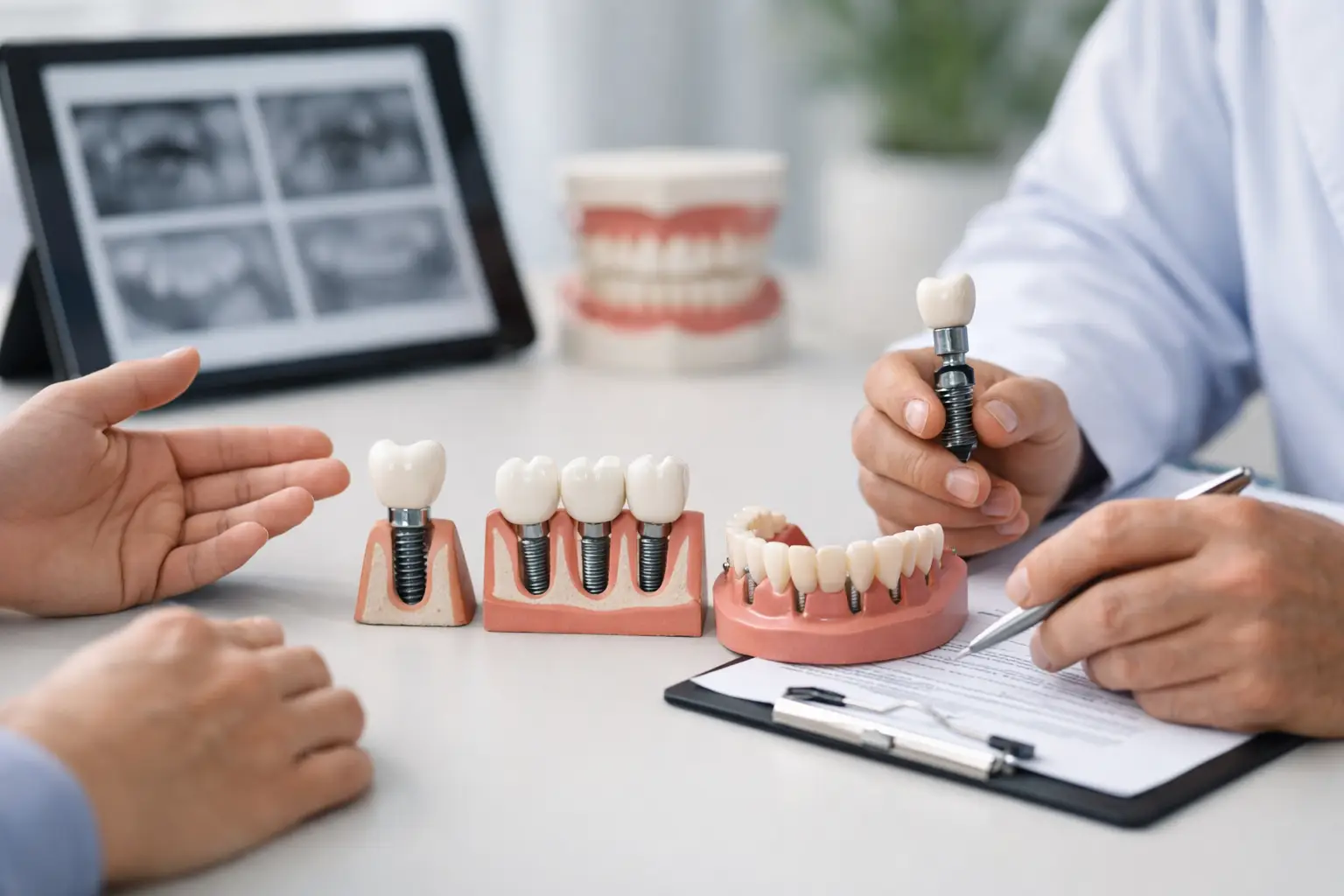
An implant is a titanium or ceramic post placed in the jawbone, usually topped with an abutment and a crown. But the same word can describe very different treatment plans. One person may need a single implant after losing one tooth. Another may be offered several implants to support a bridge, an overdenture, or a full-arch restoration.
Before comparing brands, prices, or providers, ask what problem the implant is meant to solve. Is the tooth missing already? Is it cracked below the gumline? Does it have advanced decay, a failed root canal, severe bone loss, or repeated infection? The answer matters because a tooth that can be predictably treated and maintained may not need extraction.
Ask for copies of your X-rays, clinical photos, periodontal charting, treatment plan, and itemized estimate. These records make it possible to understand whether the recommendation is based on visible clinical findings rather than a broad statement that a tooth is “bad” or that implants are simply the best option.
Compare Implant Options From Diagnosis to Final Crown
A complete implant plan has several stages, and estimates do not always include the same services. Comparing only the total at the bottom of two proposals can be misleading. One quote may include the implant, abutment, crown, scans, and follow-up visits. Another may list the surgical implant placement only.
Single implant, bridge, or removable option
For one missing tooth, a single implant with a crown may preserve the neighboring teeth because it does not require them to be filed down for a traditional bridge. It also tends to cost more upfront and requires adequate bone, healing time, and a surgical procedure.
A conventional bridge may be a reasonable alternative when adjacent teeth already need crowns or when surgery is not a good fit. It can often be completed sooner, but it relies on neighboring teeth and may be more difficult to clean under. A removable partial denture can be the least expensive route and may be appropriate as a temporary or long-term choice, though stability and comfort vary.
For several missing teeth, an implant-supported bridge or removable implant overdenture may offer different balances of cost, cleaning access, stability, and future repair needs. A fixed full-arch option can feel closer to natural teeth, but it is a major treatment decision. It may involve extractions, multiple implants, temporary teeth, bone reduction in some cases, and ongoing maintenance.
The right question is not “Which option is best?” It is “Which option is clinically appropriate for my situation, and what am I giving up or gaining with each choice?”
Implant system and restoration materials
Implant manufacturers differ in design, connection type, available components, and long-term track record. A well-established system can be helpful because compatible parts may be easier to obtain if you move or need service years later. That does not mean every premium-priced implant is automatically necessary, or that a less familiar system will fail.
Ask which implant system is proposed and whether its components are readily available in your area. Also ask what material is planned for the final crown or bridge. Zirconia, porcelain fused to metal, and other ceramics have different strengths, appearance, wear patterns, and repair considerations. Your bite, tooth position, and grinding habits matter more than a simple claim that one material is universally superior.
Immediate versus delayed placement
Some implants can be placed immediately after extraction. Others are better placed after the site heals or after bone grafting. Immediate placement may shorten the overall process, but it is not appropriate for every extraction site. Infection, bone shape, gum tissue, bite forces, and the ability to achieve implant stability can all affect the decision.
Be cautious with promises of “teeth in a day” if the plan is not clear about what you will receive that day. In many cases, the same-day tooth is a temporary restoration, while the final crown or bridge is placed after healing. That can be an excellent approach when properly planned, but you deserve to understand the timeline.
Look Closely at Bone, Gums, and Your Bite
Implants need healthy support. A treatment plan should account for bone volume, gum health, bite forces, and habits such as clenching or smoking. If a 3D scan is recommended, ask what information it will provide that a standard X-ray cannot. Cone beam CT imaging is often useful for evaluating available bone and the location of nerves or sinuses before surgery.
Bone grafting may be necessary, but its need and extent should be explained in plain language. Ask whether grafting is essential for implant placement, whether there are alternatives, and how it changes the cost and timeline. In the upper back jaw, a sinus lift may be discussed for similar reasons.
Periodontal disease also deserves attention. An implant cannot compensate for untreated gum disease or inconsistent home care. If natural teeth are being lost because of infection or bone loss, ask what is being done to control the underlying cause. Long-term implant success depends on maintenance, not just placement day.
Make an Apples-to-Apples Cost Comparison
Request an itemized estimate before deciding. A complete plan may include consultations, imaging, extraction, bone grafting, membrane materials, implant surgery, sedation, temporary teeth, the abutment, final crown or bridge, follow-up visits, and maintenance. If a quote seems much lower than another, it may exclude one or more of these items.
Also ask about foreseeable contingencies. What happens if additional grafting is needed, an implant does not integrate, or a temporary restoration breaks? Is there a warranty, and what does it cover? A warranty is not a substitute for careful planning, but it can clarify who bears certain costs.
Price matters, especially when treatment reaches thousands of dollars. Still, the least expensive plan is not always the least costly over time. A plan that leaves out diagnostic imaging, uses unclear materials, or provides little follow-up may create avoidable expense later. At the same time, a high estimate alone does not prove that more treatment is necessary.
Evaluate the Provider and the Plan, Not Just the Marketing
Implants may be placed by general dentists, oral surgeons, periodontists, or prosthodontists. Training, experience with cases like yours, and communication are more useful indicators than a title alone. Ask who will perform the surgery, who will design and place the final restoration, and how those clinicians coordinate your care.
You should also know what follow-up care looks like. Implant treatment is not finished when the crown is placed. You may need periodic exams, professional cleanings, X-rays, bite adjustments, and replacement of worn components over time. If you grind your teeth, a night guard may be part of protecting the restoration.
A trustworthy provider should be able to explain the benefits, limitations, risks, and alternatives without making you feel rushed. If you hear that an implant is the only possible answer, ask why the alternatives were ruled out.
When an Independent Review Can Help
A second opinion is especially useful when the plan includes multiple extractions, full-mouth reconstruction, extensive grafting, or a cost that feels difficult to evaluate. It can also help when two offices have offered very different recommendations.
An independent reviewer can assess the records available, identify questions to bring back to your treating dentist, and help you distinguish between a clearly supported recommendation and one that needs more explanation. Second Opinion in Dentistry provides written reviews from licensed dental professionals without performing or selling the treatment being evaluated. That separation matters when you want clear, honest feedback with no upselling and no pressure.
A remote review cannot replace an in-person examination or provide emergency care. It can, however, give you a more informed starting point before you agree to irreversible treatment.
Questions to Ask Before You Say Yes
Bring these questions to any implant consultation:
- What findings show that this tooth cannot be saved, if extraction is recommended?
- What are my reasonable alternatives to an implant, and why are they less suitable in my case?
- Does this estimate include every surgical and restorative step through the final crown or bridge?
- Will I need bone grafting, a sinus lift, or a temporary tooth, and why?
- What implant system and restoration material will be used?
- Who performs each part of treatment, and what follow-up care is included?
- What is the expected timeline, including healing before the final restoration?
- What are the most likely complications, future maintenance needs, and additional costs?
You do not need to become a dental expert to make a careful decision. You need records, clear answers, and enough time to compare what is actually being proposed. When a treatment decision affects your health and finances, asking for evidence is not delaying care. It is taking care of yourself.