
Dental Treatment Alternatives: What to Ask First
Dental treatment alternatives can protect your health and budget. Learn what to compare, which records matter, and when an independent review helps most.
A treatment plan can arrive with unfamiliar terms, several procedures, and a price that changes your plans for the year. Before you agree, ask about dental treatment alternatives. That does not mean assuming your dentist is wrong or delaying care that is genuinely urgent. It means understanding whether the recommended option is necessary now, what other clinically appropriate paths exist, and what each path asks of your health, time, and budget.
When treatment is expensive, irreversible, or presented as urgent, clear answers are not a luxury. They are part of informed consent.
What dental treatment alternatives really mean
An alternative is not always a cheaper substitute, and it is not always “do nothing.” It may be a different material, a more conservative procedure, staged treatment, monitoring, or referral to a specialist. The right option depends on your symptoms, X-rays, clinical findings, oral health history, bite, gum condition, and long-term goals.
For example, a tooth with deep decay may need a filling, an onlay, a crown, root canal treatment followed by a crown, or extraction and replacement. Those choices are not interchangeable. A filling may preserve more natural tooth structure but may not be strong enough if too much tooth is damaged. A crown can protect a weakened tooth but requires more tooth reduction. Extraction may resolve a non-restorable tooth problem, yet it creates a separate decision about whether and how to replace the missing tooth.
The useful question is not simply, “What is the least expensive option?” Ask, “What is the most conservative option that is still predictable for my condition?”
When you should ask for another option
You do not need to feel distrustful to seek more information. A second review can be reasonable when a recommendation involves multiple crowns, veneers, implants, root canals, gum surgery, extractions, orthodontic treatment, or a full-mouth reconstruction. It can also help when two dental offices have recommended very different plans.
Pay closer attention if you are told treatment must begin immediately but you do not have severe pain, swelling, trauma, fever, or a spreading infection. Some conditions are urgent. Others are important but can be planned carefully over weeks or months. Your records should help explain the difference.
You may also want to pause when the conversation leaves major questions unanswered: Why is this procedure needed? Which tooth or area is the priority? What happens if it is monitored? What are the risks of waiting? Is there a less invasive approach? How likely is each option to last?
A good dental professional should be able to discuss these questions without pressure. You are allowed to take time to understand a recommendation before authorizing treatment.
Common alternatives in major treatment decisions
Fillings, crowns, and root canals
For a cavity or cracked tooth, the alternatives often depend on how much healthy tooth remains and whether the nerve is affected. A small area of decay may be managed with a filling. A larger restoration may call for an onlay or crown. If the pulp is infected or irreversibly inflamed, root canal treatment may be recommended to retain the tooth.
In some cases, a dentist may recommend monitoring an early lesion rather than restoring it immediately, especially when it is limited to enamel and can be managed with preventive care. That is very different from delaying treatment for decay that has already reached dentin or a painful infection. X-rays, photographs, symptoms, and a clinical examination all matter.
Missing teeth and implants
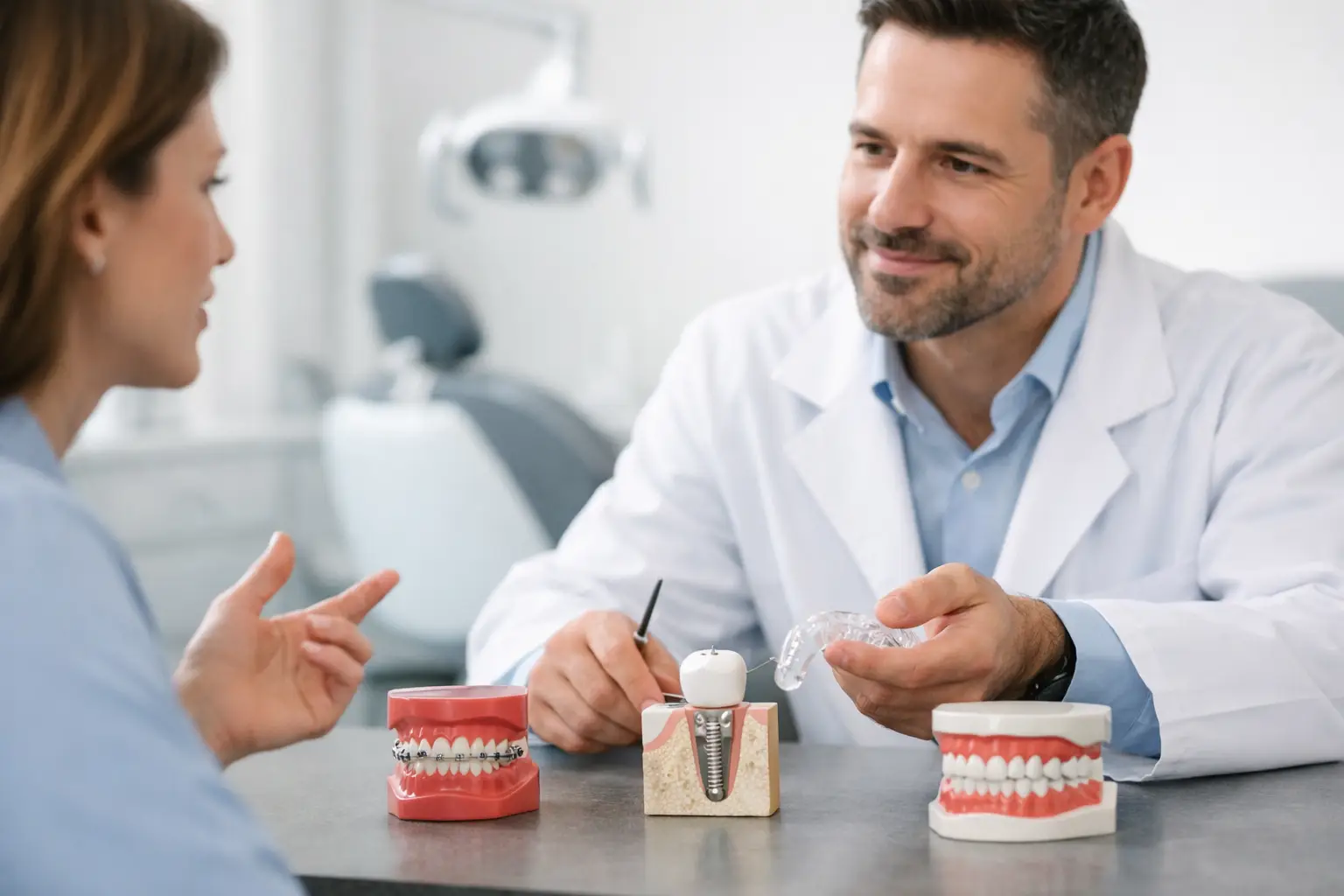
An implant is often an excellent way to replace a missing tooth, but it is not the only option. Depending on the location, bone levels, bite, neighboring teeth, and your goals, alternatives may include a fixed bridge, a removable partial denture, or leaving the space untreated with periodic monitoring.
Each has trade-offs. An implant avoids preparing adjacent teeth, but it requires surgery, healing time, adequate bone, and ongoing maintenance. A bridge can be completed more quickly in some situations but may require work on neighboring teeth. A removable option usually costs less upfront but can feel less stable and may need adjustments over time. Leaving a space may be reasonable in limited circumstances, but shifting teeth, bite changes, and chewing function should be considered.
Gum treatment and surgery
Bleeding gums, bone loss, and deep periodontal pockets may require professional cleaning below the gumline, targeted periodontal therapy, surgery, or a maintenance-focused plan. The alternative is rarely to ignore active gum disease. However, the scope and sequence of care can vary.
Before committing to extensive treatment, ask what measurements support the recommendation, whether there is active inflammation, and what improvement is expected from initial nonsurgical therapy. Some patients need specialist periodontal care. Others benefit from a reassessment after hygiene changes and deep cleaning. The goal is to treat the disease based on evidence, not to choose the largest plan by default.
Cosmetic dentistry
Cosmetic recommendations deserve especially careful discussion because they often alter healthy tooth structure. Whitening, bonding, orthodontic alignment, gum contouring, veneers, and crowns can all improve appearance, but their level of invasiveness differs significantly.
If veneers or crowns are proposed for cosmetic concerns, ask whether whitening, enamel-preserving bonding, orthodontics, or limited treatment could address your primary concern. A less invasive option may not create the identical result, but it may better fit your priorities. Once natural enamel has been reduced for a veneer or crown, that restoration will require replacement over a lifetime.
Compare options by more than the initial estimate
A lower quote is not automatically the better value, and a higher quote is not proof of better care. Compare the full picture: diagnosis, urgency, expected lifespan, maintenance, possible future procedures, risks, and what is included in the estimate.
A treatment plan should identify the teeth or areas involved, the proposed procedures, and the fees. Ask whether the estimate includes imaging, temporary restorations, laboratory work, sedation, follow-up visits, implant components, or treatment by a specialist. If a plan involves several phases, ask what must happen first and which parts can safely wait.
It also helps to separate treatment that restores health or function from treatment that is optional or cosmetic. Both may be valuable, but they should not be presented as though they carry the same urgency.
Get the records that support the recommendation
You cannot evaluate alternatives from a verbal summary alone. Request a copy of your treatment plan, itemized estimate, recent X-rays, clinical photographs if available, and relevant periodontal charting or notes. These are your health records, and they give another licensed dentist the evidence needed to assess the recommendation.
For many restorative and surgical questions, X-rays are central. They may show decay between teeth, infection around roots, bone levels, impacted teeth, or the position of planned implants. Still, X-rays have limits. They do not show every crack, the feel of a tooth, or all soft-tissue findings. A careful review should state what can be determined from records and what requires an in-person examination.
What an independent review can clarify
An independent dental review is most useful when the reviewer has no financial benefit from the procedures being considered. The purpose is not to replace your treating dentist or diagnose every detail remotely. It is to assess whether the available records support the diagnosis and proposed scope of treatment, identify reasonable alternatives or questions, and help you understand the cost implications.
Second Opinion in Dentistry provides written reviews from licensed dental professionals based on securely uploaded records, with no treatment to sell and no upselling pressure. A review can help you prepare for a follow-up conversation with your local dentist, specialist, or another provider.
A credible opinion should be direct about uncertainty. If the images are incomplete, too old, or do not show the relevant area, the reviewer should say so. If an in-person examination is needed to distinguish between two possibilities, that should be clear as well. Honest limitations are a sign of responsible care, not a weak answer.
Questions to bring back to your dentist
After reviewing your options, keep the next conversation focused. Ask which findings make the proposed treatment necessary, whether the order of treatment can change, and what the prognosis is for each option. Ask what the consequences of monitoring are and how long monitoring is reasonable. If a more conservative approach is possible, ask why it is or is not appropriate in your case.
You can also ask for a phased plan. Addressing active infection, pain, or high-risk teeth first may be sensible while you budget and decide on less urgent work. Phasing is not always appropriate, but it is a practical question for many multi-procedure plans.
The best choice is the one you understand: a plan supported by your records, aligned with your health needs, and clear about its risks, costs, and alternatives. You do not have to make a major dental decision under pressure.